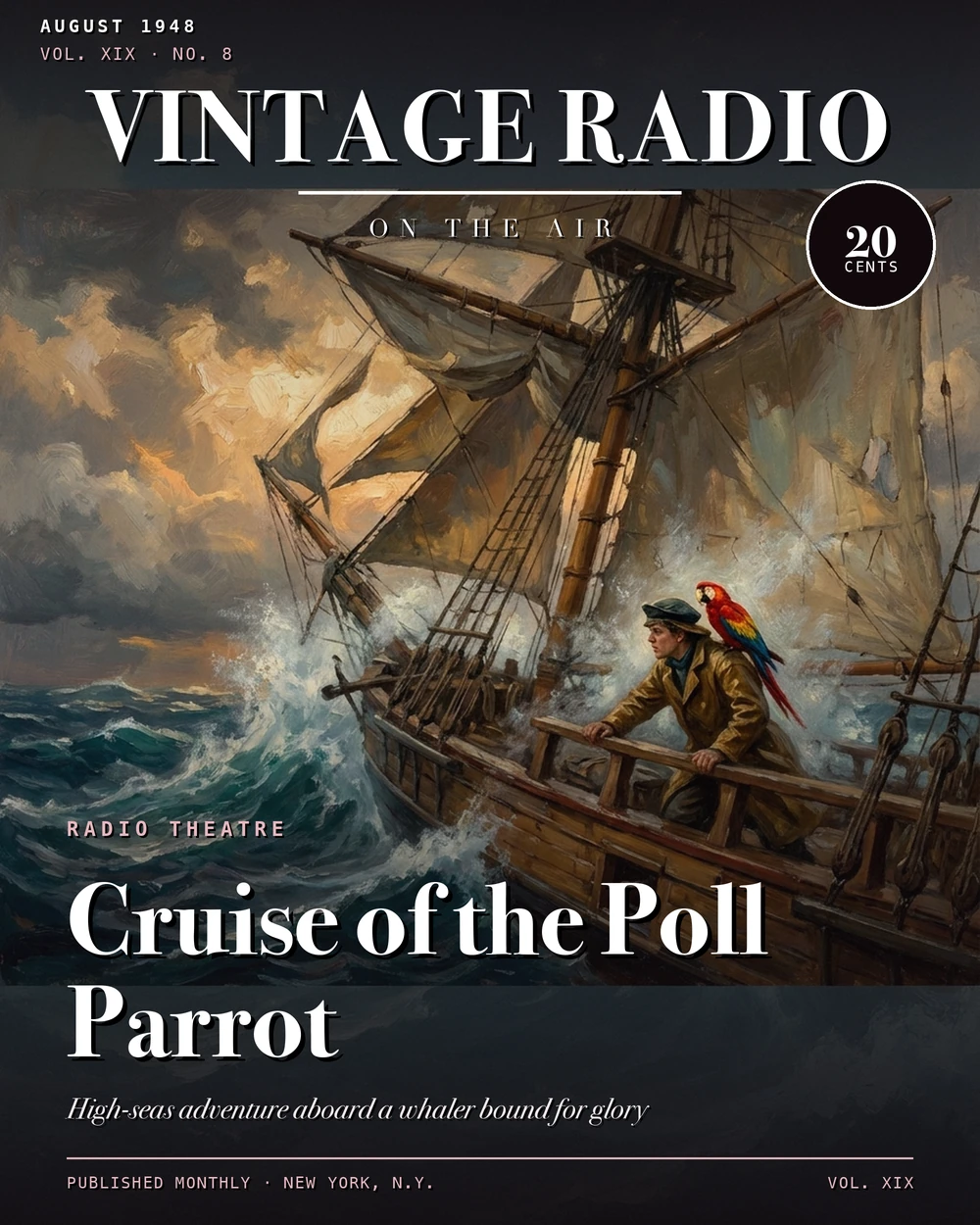
Cruise of the Poll Parrot
A Whaling Ship, Two Stowaways, and a Shoe Company
Cruise of the Poll Parrot ran from September 25, 1937 through June 18, 1938, and it arrived on American radio as something genuinely unusual: a children's Adventure serial built around whaling, set in 1858 New Bedford, Massachusetts, and engineered from the ground up to sell shoes. The International Shoe Company sponsored the series to market its Poll Parrot brand to young listeners, and they tied the whole package together neatly — the whaling ship in the story was named the Poll Parrot, the ship's mascot was a wise parrot called Poll, and the captain's pet parrot gave the sponsored brand a living presence inside every episode. It was advertising dressed up as storytelling, and by contemporaneous accounts it worked extraordinarily well.
The setup put two child stowaways — Sue Grange and Johnny Robbins — at the center of the action. Sue is the little sister of Ezra Grange, the ship's owner, which gives the children a plausible foothold in what would otherwise be an adult world of sailors and voyages. Their adventures aboard the Poll Parrot pulled in a recurring villain named Dirk, a hidden treasure, a mysterious location called El Teste, and enough shipboard peril — storms, groundings, a captured Sue, a whale kill — to hold a child audience across thirty-eight episodes. The show was written with historically researched detail, reportedly making it educational as well as entertaining, though its primary job was always to move product off shoe-store shelves.
The Syndication Strategy That Made It Work
What set Cruise of the Poll Parrot apart from most children's programming of the era was its distribution model. The show was not broadcast on a single national network. Instead, it was syndicated — sold directly to local radio stations, with local Poll Parrot shoe stores purchasing the advertising time from those stations. This arrangement kept the marketing tightly connected to the retail locations actually selling the shoes, and it gave the International Shoe Company flexibility that a network deal wouldn't have offered.
The series was packaged in blocks of thirteen episodes, and each block contained a self-contained story. A local shoe store could buy just the first thirteen, or the first twenty-six, or all thirty-nine, depending on its budget and local appetite. The modular design was practical for advertisers and kept each story arc from dangling unresolved if a station dropped the show. The series was later certified as complete, with the March 2006 release accounting for thirty-nine episodes.
The commercial result was significant. The syndication approach reportedly boosted Poll Parrot shoe sales exponentially, helping the International Shoe Company compete against Buster Brown, then the dominant children's shoe brand. The International Shoe Company already marketed Red Goose and Weatherbird shoes when it acquired the Poll Parrot line, so the radio serial was a targeted strategy for that specific brand rather than a general corporate advertising play. It was specific, structured, and by the evidence of the sales figures, effective.
The Cast and the Ship
Captain Roy Dalton, Master of the Poll Parrot, was played by Marvin Miller, who was approximately twenty-four years old at the time and working at KMOX in St. Louis — the CBS affiliate where the show was produced. Miller also voiced the captain's pet parrot, which meant he was doing double duty in nearly every scene aboard ship. That kind of double casting on a children's adventure serial was economical and, given the parrot's role as living emblem of the sponsor brand, practically necessary.
The extended cast gave the ship a full crew's worth of characters. George Wainwright served as first mate. Old Dickson was a one-legged sailor, Red Mahooley a mute crew member, and a ship keeper named Breckenridge rounded out the regular hands. El Testi — connected to the mysterious location El Teste that figures into the treasure storyline — was an agent for a rival shipping company, which positioned him as a source of intrigue and competing interests. The villain Dirk runs through multiple episodes, surfacing across story arcs to threaten Sue and Johnny and scheme around the treasure. Episode titles like Sue Is Captured, Sue Is Rescued, Sue Is Shot By Dirk, and Dirk Learns About The Treasure trace the shape of that conflict across the run.
The show was produced at KMOX, where Miller had been working as announcer and assistant chief announcer since 1932. He later recalled Cruise of the Poll Parrot fondly in interviews as one of his early KMOX programs, and the UCSB American Radio Archives Marvin Miller Collection documents the series as part of his early career. The UCSB archive describes the show, in Miller's own informal recollection, as "a children's series which took place on a pirate ship" — a characterization that doesn't square with the whaling-voyage premise all other sources confirm, and likely reflects the looseness of memory rather than the show's actual content.
Marvin Miller Before He Was Famous
At the time Cruise of the Poll Parrot was on the air, Marvin Miller was still early in a career that would eventually reach television and film. Born Marvin Elliott Mueller on July 18, 1913, in St. Louis, Missouri, he graduated from Washington University in St. Louis before starting in radio. His work at KMOX from 1932 onward gave him a foundation in announcing and voice acting, and Cruise of the Poll Parrot represented some of his first substantial acting work on radio rather than straight announcing.
He stayed at KMOX through 1939, then built a long career in radio and later in television. He became best known to American audiences as Michael Anthony, the character who delivered million-dollar checks on CBS television's The Millionaire, which ran from 1955 to 1960. He also voiced Robby the Robot in the 1956 film Forbidden Planet, a role that gave him a different kind of lasting recognition. Miller died on February 8, 1985, in Santa Monica, California, of a heart attack, at age seventy-one.
The Poll Parrot Brand and What Came After
The Poll Parrot shoe brand had a history of its own that predated the radio serial. In 1922, businessman Paul Parrot sold Poll Parrot Shoes to the International Shoe Company, and the brand's logo — a colorful parrot rendered in red, green, and gold — became a recognizable icon in children's retail through the 1930s, 1940s, and 1950s. The slogan "They Speak for Themselves" ran alongside that image for years. The radio serial fit naturally into that brand identity: the parrot was already the visual center of the brand, and giving children a ship and a captain named after it made the logo a character rather than just a label.
The International Shoe Company continued marketing Poll Parrot shoes aggressively after the radio serial ended in June 1938. In 1947, the company sponsored Howdy Doody, the popular children's television program, keeping Poll Parrot connected to children's entertainment well into the television era. The radio serial was the first major push in that direction, and by the measure of what followed, it established an approach the company found worth repeating.
The surviving episodes cover a run that lasted less than a full year but told three complete story arcs across its thirteen-episode blocks. For a syndicated children's Adventure serial from 1937, that's a reasonably intact record, and the show holds its place as an early example of how a sponsored brand could build an entire fictional world around its own name and make that world compelling enough to bring children back week after week.